Artificial intelligence is transforming education at an extraordinary pace. From lesson planning to the way children research, create and solve problems, AI is opening up exciting new possibilities for teachers and pupils alike. But as we embrace these advances, are we at risk of overlooking the value of experiences that technology simply can’t replace?
We’re delighted to welcome back Molly Potter, bestselling author, experienced educator and specialist in children’s emotional development, to explore why hands-on learning matters more than ever in an increasingly digital world.

Why Hands-On Learning Matters More Than Ever
When I taught in a pupil referral unit (PRU), I simply had to start every lesson with a hands-on experience. It didn’t need to be exciting – in fact excitement could be just as difficult to regulate as perceived threat, for many of the children I taught. What I needed was a physical introduction linked to what we were going to learn. Something they could see, touch, move, manipulate or experience to help them feel confident in their understanding before I asked them to produce anything on paper.
In fact, it was often this physical part of the lesson that contained the most learning. The shift to something more ‘abstract’ (the moment we needed to create, record, practise or explore something in exercise books) was often the point at which engagement was more likely to
disappear. Like with many things, what helps children who struggle to engage with learning is almost definitely good for all of us. What children with greater self-regulation can tolerate isn’t necessarily the best we can offer them.
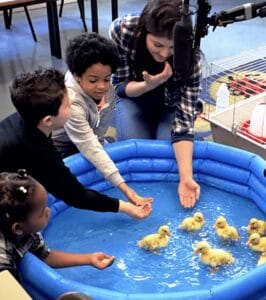
It’s no surprise really. Hands-on learning suits the way we evolved. For most of human history, when we lived as hunter-gatherers, learning wasn’t something that happened separately from doing. We learned what was safe by experiencing it, where food could be found by exploring, how things worked by trying them, observing what happened and by watching the consequences of our actions.
I also feel that hands-on activities have greater learning impact than those on paper, on screens or simply listening to descriptions. Actually doing things engages so much more of our sensory ‘being’. We are not just thinking about something – we are looking at it, moving around it, touching it, manipulating it, listening to it and then responding to what happens as a result of what we do. The 3D world is surely more captivating than the 2D one!
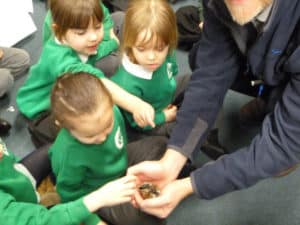
For example, when a young child builds a tower out of blocks and knocks it down, they are interacting with physical sensations, sounds, movement, balance, cause and effect and the visual information coming back to them. They can immediately change what they do and see what happens without needing to think about it abstractly. The ‘abstract’ we often put into classrooms can put a layer of thinking between the child and what they are trying to understand; instead of just experiencing it directly, they have to imagine it first. Education does generally move towards increased abstract learning as children get older, but interacting with the real world lays a foundation from which the launch into the abstract is steadier.
Hands-on learning also creates opportunities for genuine curiosity. When something is actually happening, children are more likely to have questions because they really want to know the answer. That’s dream material for teaching and learning!

Real experiences can also give learning emotional weight. A child who has observed an egg, heard the chick cheeping, waited for the shell to crack and then seen a chick emerge has a very different relationship with the words ‘life cycle’ afterwards. The words belong to something they have actually witnessed. I also saw children in the PRU most regulated and content when we took them to see small animals. Children could become remarkably gentle when there was something vulnerable in front of them. I think we can all muster up a different kind of gentleness for something we perceive so obviously as needing our care.

Hands-on learning also makes learning more social. Children have to share, take turns, communicate, wait, negotiate, observe what someone else has noticed and sometimes solve a problem together. A real object gives them something to talk about that exists outside themselves. For children who find direct social interaction difficult, having something to focus on together can make communication feel much more natural.
But like with most things – what we intuit is often correct. Would you rather draw chalk lines around a puddle and watch it shrink or just have evaporation explained to you? Would you rather be shown a picture of how a seed grows into a flower or watch the first green shoot push its way through the soil? And would you rather just be told chicks hatch from eggs or enjoy the feeling of awe as you witness one pecking its way out?

Find Out More
Head over to Molly Potter’s website, where you’ll find information about her books, top tips on developing emotional literacy and supporting behaviour and plenty of inspiration for your classroom. You can also sign up for her blog to enjoy free articles full of fresh ideas and insights.
Visit her website here: www.mollypotter.com